Sandbox LAND lets owners publish and monetize Game Maker experiences in the metaverse
Updated:Sandbox LAND lets you publish and monetize Game Maker experiences at an owned location in The Sandbox metaverse. Each plot is an ERC-721 NFT on Ethereum or Polygon. The publishing tools link that ownership to a saved experience, subject to its footprint, asset permissions and launch settings. Creating a game or sharing a free Experience Page does not require LAND; placing playable content on the metaverse Map requires suitable owned space.
Gallery Sharing, Project Pages and Metaverse Launches
Game Maker supports free Gallery sharing and an Experience Page for promotion; owned LAND enables metaverse Map publication.
Gallery Sharing
The Game Maker Gallery allows free sharing of experiences without owning a plot. It supports testing and community participation, including Game Jam submissions. A game can therefore reach other users before its creator acquires publishing space. Gallery sharing does not assign the project an owned location on the metaverse Map.
Project Pages
An Experience Page presents a project through descriptions, images and trailers. Its creator can publish this page without LAND and share its address with an audience. This supports promotion before a metaverse release. The page describes the experience; publishing the page and launching its gameplay remain separate actions.
Metaverse Publication
LAND provides the Map location for a Game Maker experience launched through Experience Manager. The selected space must fit the project, and its assets must meet publishing requirements. Regular plots support this function as well as Premium LAND. Buying a premium location is unnecessary merely to obtain the ability to publish.
Experience Inventory and Launch Readiness
Experience Manager prepares a saved Game Maker project for launch from the publishing account's experience inventory. LAND ownership alone leaves other requirements outstanding.
The manager brings together the Experience Page, Map Location, Asset Review and compatibility checks. Required page fields need completion, and asset review needs to pass before release. Access restrictions add optional entry conditions. Preparation tasks can proceed in different orders, but the required actions must reach Ready status before the Launch control activates. A published promotional page can still have a disabled Play button because its experience has not launched. An opening date in the future also keeps gameplay closed until that date.
LAND Footprints, Adjacency and Estate Placement
A project's footprint determines the LAND layout it needs, including the width and length of its publishing space. A single LAND has a buildable space measuring 96 by 96 blocks horizontally and 128 blocks vertically. A 1x1 experience fits a single parcel. Larger experiences need enough adjacent space in the appropriate arrangement. Game Maker fixes the experience size when the project is created, so acquiring additional plots does not resize an existing game. Vertical construction uses the plot's height without changing its horizontal footprint.
An Estate groups adjacent LAND NFTs into a larger parcel and can accommodate multiple experiences in available space. Unmerged adjacent plots also support publication through the Location tool's Combinations option where it is available. Those plots must touch along their sides and match the experience's shape. The same parcel count in a different arrangement does not establish a fit. Earlier placement tools restricted larger experiences to Estates, so available controls matter when selecting a layout. Space already occupied by another published experience is unavailable for overlapping placement.
Asset Ownership and Public Availability
Asset Review checks whether the experience's objects are usable for publication under the publishing account and connected wallet.
Custom VoxEdit Assets
VoxEdit creations can populate their creator's own experiences without minting those models as NFTs. Minting for sale is a separate operation. Assets used in a launched experience need public availability, including custom creations previously kept private. The launch process can request confirmation to publish those assets automatically. This changes their sharing status, so a private work-in-progress model deserves attention before that confirmation.
Marketplace Assets in a Draft
Marketplace previews let a builder test some assets before purchasing them. An object appearing correctly in Game Maker does not establish publishing ownership. Asset Review distinguishes Ready objects from Unavailable assets and NFTs to Buy. A creator can purchase an eligible missing NFT or replace it with an asset they own. Unavailable objects require replacement, including items withdrawn from availability or no longer obtainable. Changing the draft's assets requires another review of the revised experience.
A Planned Opening With an Unavailable Asset
In this hypothetical example, an owner has a saved experience, suitable owned LAND and completed page fields. Its planned opening is approaching. The draft includes a Marketplace NFT the owner tested but has not purchased.
While the NFT remains available, purchasing it supplies the missing ownership requirement. The wallet's NFT inventory independently confirms receipt, and Asset Review can move the object out of NFTs to Buy. With the remaining requirements ready, the project qualifies for launch.
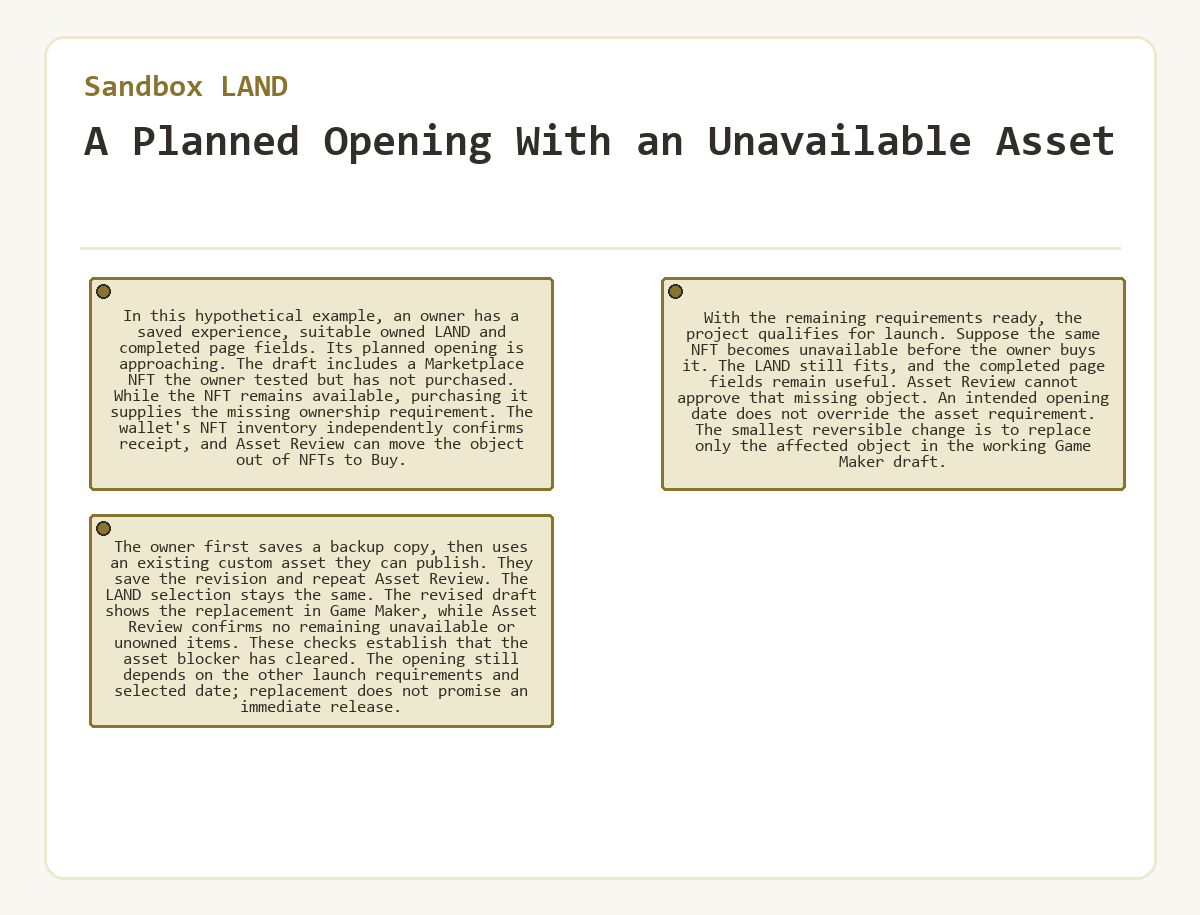
Suppose the same NFT becomes unavailable before the owner buys it. The LAND still fits, and the completed page fields remain useful. Asset Review cannot approve that missing object. An intended opening date does not override the asset requirement.
The smallest reversible change is to replace only the affected object in the working Game Maker draft. The owner first saves a backup copy, then uses an existing custom asset they can publish. They save the revision and repeat Asset Review. The LAND selection stays the same.
The revised draft shows the replacement in Game Maker, while Asset Review confirms no remaining unavailable or unowned items. These checks establish that the asset blocker has cleared. The opening still depends on the other launch requirements and selected date; replacement does not promise an immediate release.
NFT Access, Content Sales and Revenue
Game Maker's LAND publishing tools monetize access through NFT sales, with advertising space providing another possible income source.
Experience Entry and In-Game Gates
Entry restrictions can require a specific NFT or an avatar from a selected collection. Avatar-based entry requirements include equipping the qualifying avatar. Within an experience, the NFT Sensor can connect ownership checks to gameplay logic, such as access to exclusive areas or perks. These are separate levels of access control. The documented Game Maker publishing model uses NFT sales to monetize access and does not collect a direct SAND admission charge. Holding LAND does not automatically impose a paid gate on visitors.
Asset Sales and Advertising Space
Creators can mint voxel assets for sale through the Polygon Marketplace and give those NFTs utility in their games. Selling an asset supplies a potential revenue source; checking a visitor's NFT merely applies the access condition. Owners can also offer advertising space inside an experience, including billboards or sponsored quests. Revenue depends on an actual sale or commercial arrangement. The former SAND staking pools closed in June 2025, so their historical LAND-owner benefits should not enter a current publishing-income calculation.
Updates, Relocation and Temporary Closure
Experience Page edits can change a published page immediately when saved, while relocating gameplay requires closing the experience first. Text and media updates therefore differ from changing its LAND assignment. Previewing page changes before saving helps avoid publishing unfinished presentation material. A gameplay revision also needs attention to its included assets and compatibility, because earlier readiness describes the earlier draft. The manager distinguishes a launched version from a draft being modified, making the release state separate from work in progress.
Closing an experience removes its availability and unpublishes its Experience Page. Publishing tools retain its configuration for a subsequent launch. A location change then needs suitable owned space for the new assignment. Closure creates an interruption for visitors, even when the intended change only concerns placement. Moving content between plots does not expand its footprint or resolve an asset-ownership problem.
Premium Locations and Audience Signals
Premium LAND sits near major partners or social hubs, giving its location potential discovery advantages. Those surroundings do not establish a particular visitor count or sales volume. Experience Analytics separates page traffic from gameplay traffic when its tab becomes available for the experience's player metrics. A promotional page visit is different from a play session, and repeat sessions can come from the same player. These distinctions help assess how a location and its content attract participation without treating every visit as revenue.
Publishing Control and Creative Ownership
A LAND NFT identifies plot ownership, while a game's designers retain copyright in their original work. Content must respect others' copyrights and trademarks. A commissioned experience needs to reach the publishing account's inventory before its owner can launch it. Publishing also requires suitable LAND and any purchased NFT assets used in the experience to be held in its connected wallet. Uploading publicly shared games grants The Sandbox a worldwide license to use, reproduce, display, distribute and adapt that content for its services and promotion. The license is non-exclusive, royalty-free, perpetual and irrevocable, with sublicensing and transfer rights.
Private hosting or rental arrangements still require the appropriate account inventory and connected-wallet holdings. They can place project control with another account holder. Experience transfers and transfers of unminted assets can use account details without an NFT wallet transaction. NFT transfers separately require wallet authorization. A collaboration should specify delivery and permitted use of the game and assets. Giving a builder account passwords can expose unrelated project transfers.
Ethereum and Polygon Ownership
LAND exists on Ethereum and Polygon, and The Sandbox Bridge supports moving parcels between those networks. Bridging changes the network representation of the holding.
Network confirmation and the platform's inventory display can update at different times. A signed transaction authorizes an operation; it does not prove the bridge has completed. Transaction History reports bridge progress, and the destination blockchain's ownership record provides a separate check on the parcel. Network congestion affects processing. A Polygon-to-Ethereum withdrawal also requires confirmation at the checkpoint to continue. A launch plan needs time for the transfer to finish and the platform's ownership display to update. Bridging does not substitute for linking the correct LAND to the experience or completing its publishing requirements.
LAND and The Sandbox Studio
The Sandbox Studio announced prospective LAND roles on June 9, 2026, including featured game placement, priority access to new games and decentralized AI compute. Placement concerns game discovery, while the compute proposal concerns platform infrastructure. Studio also supports web and Telegram distribution. These announced long-term roles have a different product scope from Game Maker's LAND-based metaverse publication; they should not be treated as immediate entitlements accompanying a plot purchase.
Practical questions about Sandbox LAND
Are Exclusive Assets Included When I Buy Premium LAND second-hand?
A second-hand Premium LAND purchase includes its original exclusive assets only if the seller expressly bundles them with the plot. Initial-sale extras do not automatically accompany a later resale. The purchase terms determine which NFTs change hands. This matters for publication because a model shown beside a plot may still be a separate asset you need to own before using it.
Can I Reuse a Purchased NFT Asset Across Several LAND Plots?
A purchased NFT asset permits use on one LAND per asset owned. Assets you create in VoxEdit and upload to your Workspace have different treatment: you can use them across your LANDs without minting them as NFTs. Expanding publication across plots therefore requires distinguishing purchased copies from your own uploaded creations.
Why Is LAND Bought on a Secondary Marketplace Missing From My Account Inventory?
Secondary-market LAND appears in the account inventory when the NFT belongs to the wallet connected to that account. Ownership in another wallet does not satisfy that display condition. Compare the purchase's recipient address with the connected wallet address before treating the missing entry as a failed purchase.
When Do Edited NFT Entry Rules Take Effect in a LAND Experience?
Changes to an experience's access restrictions apply within minutes under the documented publishing behavior. They do not necessarily take effect at the instant of saving. This timing differs from Experience Page content edits, which become visible when saved. Changing the page's promotional wording does not change its NFT entry rule.
Can an Unfinished LAND Plot Have Its Own Map Image?
A LAND plot can have custom Map details before it has a linked playable experience. Its owner can change the name, description and thumbnail, with additional media options available in the customization controls. These details can introduce a planned project. They do not launch gameplay, and uploaded content remains subject to the platform's content rules.
Is Account Verification Necessary to Buy LAND in a Public Sale?
Public LAND sales require a verified account with a linked wallet, and banned accounts cannot participate. Verification uses KYC, meaning Know Your Customer. This requirement governs purchase eligibility. It is separate from the project, LAND and asset checks required to publish a Game Maker experience.