Sandbox wallet changes can affect access to pending reward claims
Updated:Sandbox wallet changes can affect which pending SAND or NFT reward claims appear on your account. Existing smart contracts do not change when you replace the connected wallet, so visibility can depend on its association and when the platform created the claim. Disconnecting also leaves assets in the previous wallet. For a planned change involving an uncompromised wallet, claiming available rewards first can avoid interrupted access. Reconnecting that wallet to the same account may reveal an outstanding claim, provided its contract still permits redemption. Pending sale proceeds and funds remaining in former staking pools have separate wallet associations to consider.
Account Connections and Wallet-Bound Activity
The account provides access to platform services, while its connected wallet identifies the assets and blockchain activity available through that connection. A reward claim can therefore depend on more than the account currently signed in. The wallet connected during the relevant activity and the platform's claim-creation timing can affect what appears. Replacing the connection does not rewrite those earlier contracts. The same distinction matters when a balance remains visible in a wallet application but disappears from the account.
Changing an account connection, claiming a reward and transferring an owned token perform different jobs. The first changes access through the platform. A claim requests an eligible reward through its existing terms. A transfer moves tokens already held at an address. Treating these operations as interchangeable can leave an outstanding claim unresolved even after an account accepts a replacement wallet.
What Changes When You Disconnect Your Wallet?
Disconnecting removes the platform's access to the previous wallet's data without deleting the account, wallet or assets. SAND, LAND and avatar NFTs held there stop appearing through that account connection. The wallet provider's application or extension can still provide access to those holdings. A missing balance in the account therefore does not establish a transfer or loss. The distinction applies to already-owned assets; an unclaimed reward still depends on its separate eligibility and redemption conditions.
Unclaimed Rewards and Distribution Timing
Reward availability depends on distribution as well as participation, so a completed event can precede an available claim. A missing entry after a wallet switch may reflect claim-creation timing, an unreleased distribution or another eligibility condition. The event's distribution date helps distinguish those possibilities. A newly connected address alone does not establish which condition applies, and the absence of an entry does not prove the platform cancelled the reward.
The current reward-claim policy sets a three-month expiry measured from the distribution date for new claims. Earlier claims followed a policy without an expiration date. An applicable expiry appears beside the available claim. Distribution, rather than the day of a wallet change, determines the new claim's redemption window. Waiting for a replacement connection or another transaction allowance does not extend that window.
An expired claim no longer provides access to its reward.
Can Reconnecting the Previous Wallet Reveal Pending Claims?
Reconnecting the previous wallet to the same account may reveal pending claims when their contracts still permit redemption. Access depends on the particular contract and its time limits, so reconnection does not promise recovery. The earlier address must also remain accessible through its wallet. Knowing an address and controlling the wallet are separate requirements; an account connection cannot replace the credentials needed to use that wallet.
The platform allows a previously disconnected wallet to reconnect to its original account. A wallet previously used with a different account is ineligible for that connection. Keeping the original account preserves the supported reconnection option. Creating another account does not redirect an earlier contract or make the previous wallet available there. Expiration and event eligibility still apply when the original connection returns.
A Missing Claim After a Wallet Switch
Consider a hypothetical SAND claim associated with the previous wallet. Assume the account has completed identity verification, the claim remains open and the wallet is uncompromised and accessible. After connecting a different address, the account no longer displays that claim. Would sending existing SAND to the new address also move the outstanding reward claim?
A SAND transfer moves tokens already held in the sending wallet. It leaves the pending claim's contract unchanged. The transfer would put the existing SAND balance at the replacement address, while the outstanding reward would remain subject to its earlier wallet association.
In this example, assume reconnecting the earlier wallet to the same account makes the open claim appear again. Claiming still requires authorization and the claim's remaining conditions. An expired claim would not become available through the same reconnection.
Claims, Wallet Authorization and Network Fees
Reward claims on the Claims page require completed KYC, or Know Your Customer, verification. Connecting a replacement wallet does not satisfy that identity requirement.
Claim Authorization
Selecting Claim requests wallet confirmation for an eligible reward. The confirmation includes transaction details and any gas charge. Signing authorizes the transaction; the prompt alone does not establish token delivery. Blockchain congestion affects when the reward reaches the wallet. Account sign-in and claim authorization consequently serve different functions, even when the same connected wallet supports both.
Polygon Network Fees
Polygon processes the reward-claim transactions. Gas fees compensate network validators, and congestion affects the cost of a paid transaction.
Gasless Transactions
Remaining gasless transactions can cover the network fee for a claim. The Claims page displays the remaining allowance and its renewal date. Those details matter when an outstanding reward approaches expiration. Waiting for renewal is available when the claim remains open long enough; an earlier deadline can make a paid claim relevant.
POL for Paid Claims
Paid Polygon claims require POL for gas. The SAND reward and the POL gas balance serve separate purposes. Pay Gas Fees in SAND ended on January 23, 2025, while gasless transactions continued. Holding SAND therefore does not by itself cover a paid claim's network charge. The wallet confirmation displays the fee applicable to the transaction, rather than a fixed amount for every reward.
Proceeds From Listings Created Before the Switch
Proceeds from creator NFTs listed on the Marketplace go to the wallet connected when the creator listed them. The wallet connected at the later sale does not replace that recipient. Expected earnings may therefore arrive in the previous wallet after an account switch. This rule concerns sale proceeds from those listings, rather than pending event rewards. A seller checking an apparent shortfall needs to distinguish money already paid to the earlier address from a reward awaiting distribution or redemption.
Older Staked SAND and Withdrawals
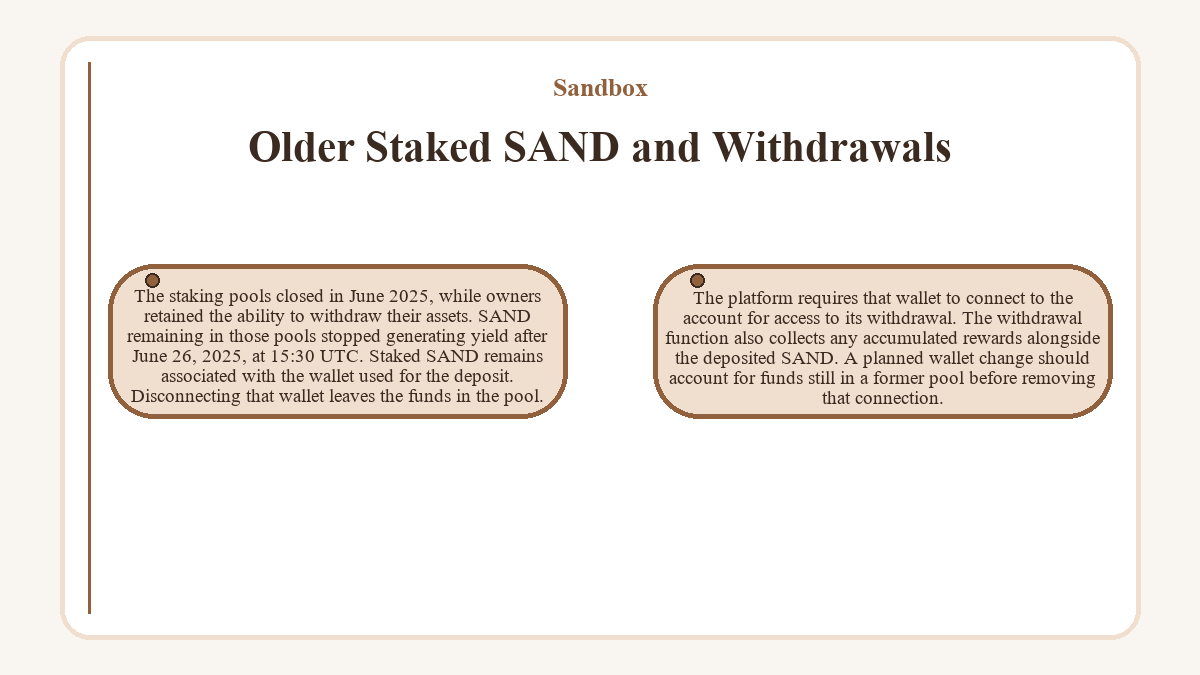
The staking pools closed in June 2025, while owners retained the ability to withdraw their assets. SAND remaining in those pools stopped generating yield after June 26, 2025, at 15:30 UTC.
Staked SAND remains associated with the wallet used for the deposit. Disconnecting that wallet leaves the funds in the pool. The platform requires that wallet to connect to the account for access to its withdrawal. The withdrawal function also collects any accumulated rewards alongside the deposited SAND. A planned wallet change should account for funds still in a former pool before removing that connection.
Moving Claimed SAND and NFTs
Received SAND and NFTs can move through asset transfers independently of a pending claim. SAND transfers use the wallet's sending function. NFT transfers use supported wallet or marketplace transfer features. Changing the account connection does not carry out either transfer. LAND already held in the earlier wallet remains there until an asset transfer changes its owner address; reconnecting simply restores the platform's access to that wallet's data.
SAND and LAND exist on Ethereum and Polygon, so the asset's network remains relevant to any transfer. Replacing a wallet address and moving between networks are separate operations. The destination address must be correct before a transfer begins. Tokens sent to an incorrect address cannot be recovered through an account wallet change. Moving a claimed asset also leaves unrelated pending claims and earlier sale recipients subject to their existing associations.
Compromised Wallets and Confirmation Access
A compromised wallet changes the priorities of a planned account switch. Disconnecting removes platform access; it does not remove an attacker's control over exposed wallet credentials. The wallet provider handles investigation of that compromise. The Sandbox cannot recover stolen funds or NFTs. Reconnecting an exposed wallet merely to restore a reward entry does not resolve the underlying security problem.
The disconnection process requires confirmation through the email address saved in the account profile. Access to that mailbox matters before beginning a replacement. The account presents a warning about losing access to wallet content, then requests email confirmation. Its acknowledgement checkbox and email confirmation concern unlinking; neither authorizes a token transfer. For an uncompromised wallet, consider completing an available claim or withdrawal before disconnecting it. If the wallet is compromised, stop using it and connect a new wallet to the account.
Sandbox - your questions answered
Does Switching Wallets Require Me to Repeat KYC on the Same Account?
Disconnecting a wallet does not change completed KYC verification on the same account. Identity verification belongs to the account, while claims can retain relationships with earlier wallets. Keeping that verified account avoids treating a wallet replacement as a new registration. Separate reward eligibility conditions still apply to an outstanding claim.
Why Does Importing SAND Into a Replacement Wallet Leave My Old Balance Behind?
Importing SAND adds the token to a wallet interface without transferring a balance from another address. It helps the wallet display the selected token on its network. SAND owned by the previous address requires an asset transfer to change its location. Importing the token also leaves any pending reward claim unchanged.
Where Can I Find the Wallet Address I Disconnected From My Account?
Wallet settings show details of wallets previously connected to the account, alongside the current wallet address. That record can help identify the earlier address associated with an outstanding claim or sale. It identifies the wallet; it does not provide its password, recovery phrase or authority to sign a transaction.
What Does a Wallet Locked Error Mean When I Claim With a Reconnected Wallet?
A Wallet Locked error means the platform cannot access the wallet because it is locked or logged out. Unlocking it through the wallet provider's sign-in controls addresses that access problem. The error does not by itself establish a missing reward or changed eligibility. Lock the wallet again after use.
Could a Raffle Explain a Missing Reward After I Reconnect My Old Wallet?
A raffle can leave eligible entrants without a reward because only selected winners receive claims. Reconnecting an earlier wallet does not turn participation into a winning entry. The distribution date and the event's entry requirements also matter. A missing claim may reflect those conditions even when the earlier wallet connects successfully.
Can the Sandbox Recover My Forgotten Wallet Password After I Change Connections?
The Sandbox cannot recover a third-party wallet password through an account connection change. Recovery depends on the wallet provider's tools and the credentials you retained. Contact that provider if its recovery process does not restore access. Never disclose a wallet password, private key or recovery phrase to someone claiming to handle a missing reward.